Bowie, Maryland
Basement Water Damage Restoration in Bowie, MD
Basement Water Damage Restoration in Bowie, Maryland, with published price ranges up front, the loss scoped with moisture readings on site, and one written figure before any work begins.

Bowie, Maryland
Basement Water Damage Restoration in Bowie, Maryland, with published price ranges up front, the loss scoped with moisture readings on site, and one written figure before any work begins.
In Bowie, the basement is rarely just storage. It is the family room, the guest suite, the home office, the kids play space, sometimes all four divided by drywall and good intentions. We restore basement water damage in Bowie, handling the extraction, material decisions, drying, and cleanup that turn a soaked lower level back into usable, healthy space.
Below grade rooms fail differently from upstairs rooms. Water arrives from above through a leaking supply line, from below through a slab and sump system, and from the sides through foundation walls after heavy rain. A basement can also collect water from all three directions in a single bad week. Restoration has to identify every entry route, because drying a room while groundwater still presses at a cove joint only resets the clock.
Sump pump failure leads the list. The pump sits quiet for months, then a summer thunderstorm knocks out power or the float sticks during the exact storm that fills the pit fastest. Water rises over the pit rim and spreads across the lowest floor in the house, which in Mitchellville and Woodmore often means finished carpet, a bathroom, and built in storage.
Plumbing failures come second. Basement bathrooms, laundry rooms, and water heaters concentrate pipes and drains in one level. A water heater that lets go can release its full tank plus the incoming supply until someone closes a valve. Washing machine hoses age out quietly. Ejector pumps serving basement bathrooms fail with messier consequences, since that water is handled as contaminated.
Groundwater and storm intrusion round out the pattern. Bowie clay holds rain against foundations, and water follows the path of least resistance through a floor joint or a crack that stayed hairline for years. Window wells fill like buckets when their drains clog with leaves, and at grade basement entries take wind driven rain at the threshold seal.
Assessment maps the whole level before equipment moves in. We meter walls, flooring transitions, and partition bases that look dry from the finished side, since partitions over a slab can wick moisture into framing that shows no stain at all. The bathroom gets checked even when visible water stopped two rooms away, because tile hides subfloor moisture well.
Extraction and material calls follow. Carpet in a clean water loss may be lifted, pad removed, and the carpet later dried and reset, while carpet soaked by sump overflow mixed with floor drain backup gets a harder look. Baseboards come off where walls are wet so air can reach the sill. Wet insulation inside a finished wall section comes out when it exists, since fiberglass that matted down wet will not dry in place inside a closed cavity in any reasonable time.
Drying a finished basement rewards patience and containment. We often split a large Mitchellville basement into zones, so a zone that finishes early releases its machines to help the lagging zone. Dehumidification drainage gets routed to a drain outside the drying chamber, a small detail that keeps conditioned air dry.
Cleanup closes the physical work. Concrete and tile get washed, framing gets cleaned where silt reached it, and any odor source gets named honestly. Finding that source matters more than masking it.
An unfinished basement looks simpler and hides its own traps. Stored belongings sit directly on concrete, and water spreads under storage rows and wicks into every box bottom before a homeowner sees a puddle at the stairs.
Our approach there leans toward contents handling and slab drying. Belongings get lifted, sorted wet from dry, and staged off the floor. The slab gets dried with attention to the cove joint where wall meets floor, which can weep moisture long after the open floor reads dry. Appliance bases get checked underneath, and adjoining crawl spaces in older Belair sections get inspected too, since they share air with the level above.
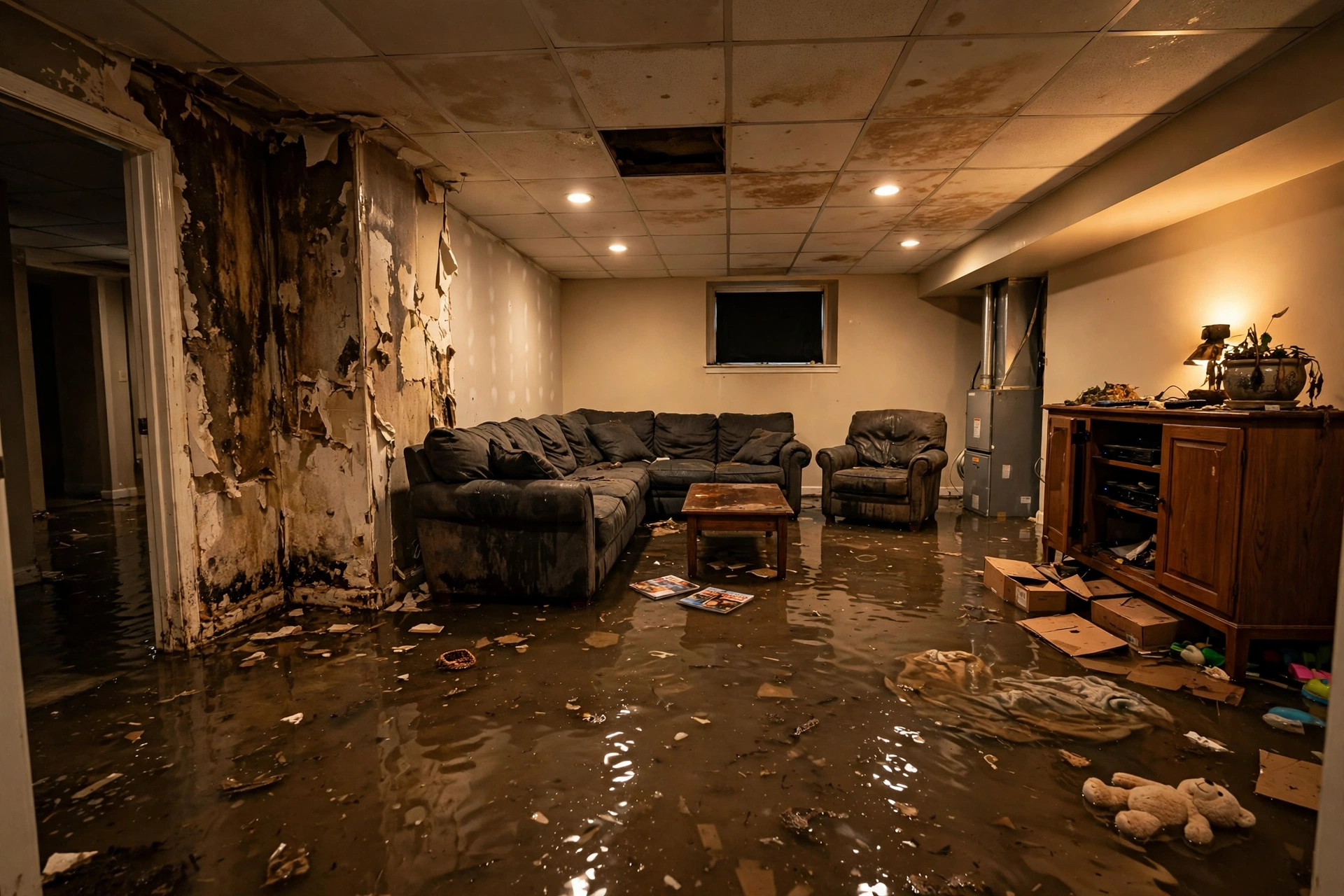
A sump pump failed during an overnight storm in Mitchellville and water spread across a finished basement with a family room, guest bedroom, and bathroom. We extracted the water, removed saturated pad and a run of wet baseboard and lower wall insulation, and split the level into two drying zones for carpet areas and the tiled bathroom. Monitored drying brought the slab, framing, and remaining carpet to dry standard, and all surfaces were cleaned before equipment was pulled.
No Bowie company publishes a local price list, so the figures here are published figures from national cost guides, labeled as such. Published figures put water mitigation commonly at $1,300 to $5,800 per project, and basement water damage restoration for a typical Bowie home usually falls at $1,900 to $5,200. Published guides put an average restoration project at $3,000 to $3,867, and a large finished basement with several rooms can run above that average once material removal and zoned drying are counted.
Finished area is the biggest driver. An unfinished utility basement costs far less than a finished level with carpet, partitions, a bathroom, and built ins. Contaminated water adds removal steps, and late discovered losses add drying days. For context only, published data puts a full insurance claim project including rebuild at around $13,954 on average, an insurance claim figure including rebuild, not a basement price on its own. Your firm figure follows the full level assessment.
Restoration ends with a short, practical review. Test the sump pump by filling the pit, and consider a battery backup unit if the home loses power during storms. Replace washing machine hoses on age, not appearance. Keep storage on shelving rather than directly on concrete, with a small gap at foundation walls so a minor weep gets spotted early.
Downspouts that dump beside the foundation feed the cove joint that just dried, and window well drains need clearing each fall. None of that work is our trade, and we say so, but the readings from your loss point at the likely entry route.
Published figures put water mitigation commonly at $1,300 to $5,800, with basement restoration usually at $1,900 to $5,200 for a typical Bowie home. Published guides put an average restoration project at $3,000 to $3,867. Finished area, water source, and material removal set your place in the range, confirmed by the on site assessment.
Often, yes, in clean water losses caught reasonably early. Baseboards, pad, and selected wet sections may come out while most finishes stay and dry in place. Sump overflow mixed with drain backup, long delays, or flood water change that answer, because contaminated or long wet materials need removal for the space to be healthy again.
Tell us right away if water reenters at any point. A second intrusion pauses the drying clock for the affected zone until the new water is extracted and the source is addressed. That honesty in the log protects both the result and your claim record, since readings must match the real sequence of events.
Dry belongings can stay if they are lifted off the floor and moved clear of work zones and air paths. Wet belongings need sorting, and porous items that sat in contaminated water may need disposal. Cardboard boxes that took moisture should be replaced with plastic bins once the space is dry.
Concrete releases moisture slowly, so we take repeated readings at the slab and at the cove joint over the drying period and look for values that hold steady at dry standard on consecutive checks. A single early low reading is not enough for a slab, especially after groundwater pressure from saturated clay soil.
In most clean water losses, thorough drying and cleaning return the space to a normal smell. Lingering odor usually traces to a missed source, such as wet insulation in one wall section. Monitoring includes checking for those sources before equipment leaves.
Tell us what got wet and when. We read every request that comes in and respond with the published range for that kind of loss and the next step, starting with a visit to take moisture readings and scope the drying plan.
Prefer to talk it through first? Send the form and we will call you back at the number you give us.