Bowie, Maryland
Storm Damage Restoration in Bowie, MD
Storm Damage Restoration in Bowie, Maryland, with published price ranges up front, the loss scoped with moisture readings on site, and one written figure before any work begins.

Bowie, Maryland
Storm Damage Restoration in Bowie, Maryland, with published price ranges up front, the loss scoped with moisture readings on site, and one written figure before any work begins.
Bowie storms do not need a hurricane name to flood a house. A summer cell can drop inches of rain in an hour on clay soil that drains slowly, and water finds the low door, the window well, the basement wall, and the sump basin all in the same evening. We handle storm damage restoration in Bowie by removing storm water and debris, cleaning what it touched, and drying the structure across every entry point, not just the wettest room.
One storm often creates several losses in one address, roof water at the top and groundwater at the bottom.
Ground entry is the classic pattern. Rain saturates clay soil, water pools against foundation walls, and pressure pushes it through cracks, joints, and the floor slab edge. Window wells fill and spill at the sill. Low rear entries let sheet water cross a threshold during the heaviest band of rain.
Top down entry looks different. Wind driven rain gets under lifted shingles and around flashing, then shows as a ceiling stain hours after the storm moved on. A fallen limb can open a roof in minutes. Low lots flood first, including homes near the Collington branch and on the Patuxent River side of the city, plus White Marsh streets where yards slope toward the house. Sump pumps run hard through these events, and a pump failure turns ground entry into a full basement loss.
Storm water is not clean supply water. It carries soil, yard chemicals, and bacteria, so porous materials it soaked are handled as contaminated. Carpet and pad crossed by yard water generally come out. Hard surfaces are washed and treated once silt and debris are removed.
Silt changes the labor. Mud coats slab edges and packs into the bottom of a finished basement, so removal happens before drying equipment is set. Once debris is out, dehumidifiers and air movers dry framing, masonry, and subfloor to readings checked each day under the IICRC S500 standard. Any active roof or window entry is noted for the repair trade.
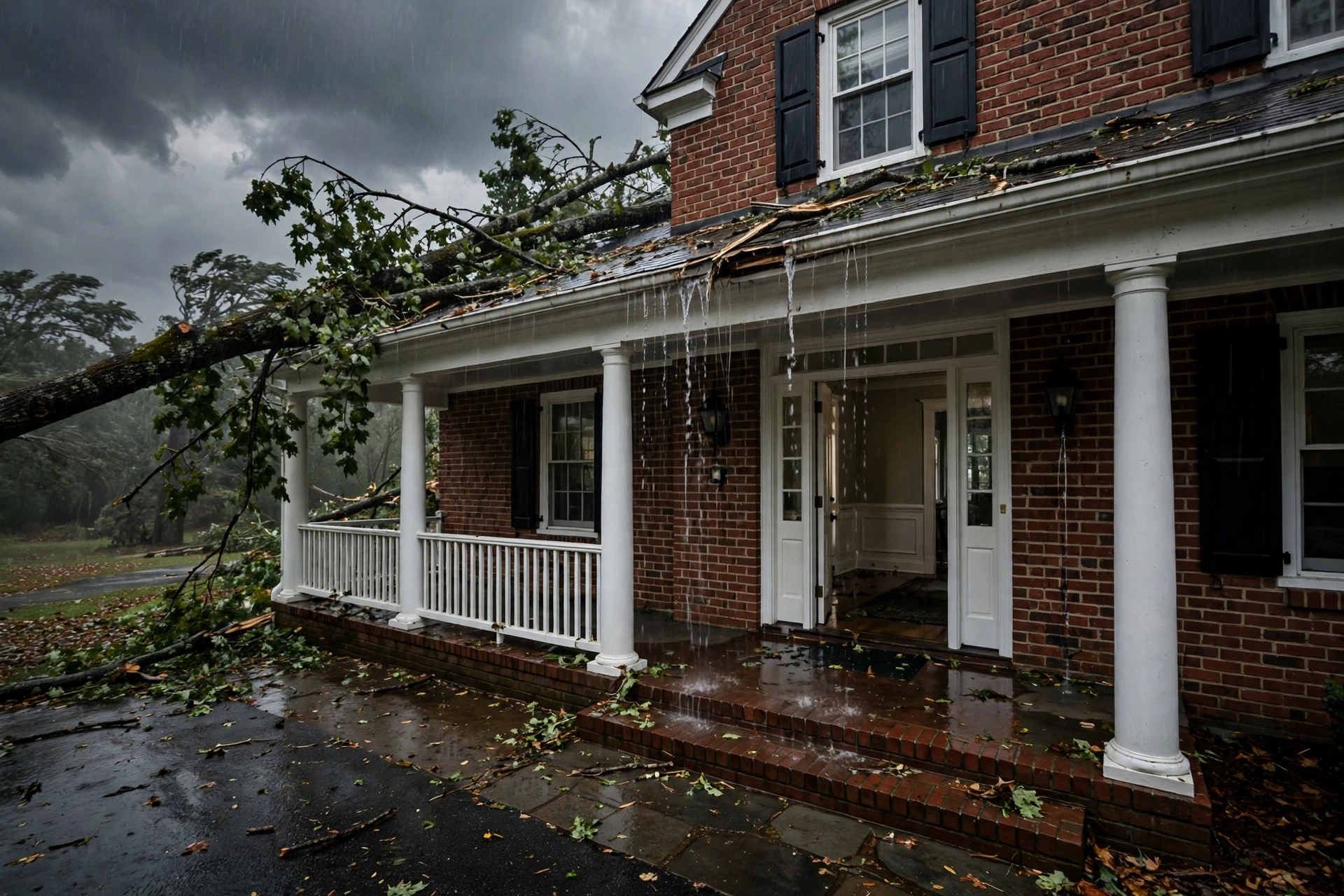
A hard summer storm in White Marsh drove yard water through a low rear door and across a finished basement, while wind driven rain entered at a lifted flashing line and wet an upstairs ceiling. We removed silt and the contaminated carpet and pad below, washed and treated hard surfaces, and removed the wet ceiling section above to dry the roof framing. Drying ran on both levels until slab, wall, and ceiling readings all returned to dry range.
No Bowie company publishes a local price list, so these planning figures are published figures, labeled as such. For this service, published figures in the brief put storm damage restoration at $2,800 to $6,400. Published guides put water mitigation commonly at $1,300 to $5,800, and the average restoration project at $3,000 to $3,867 in published cost guides.
Storm scope explains the spread. One basement entry with hard floors sits lower. Two levels of entry, silt removal, contaminated carpet, and ceiling work sit higher.
A dried house can flood again through the same door next month. Part of a storm visit is naming the entry points clearly, low thresholds, filled window wells, soil graded toward the wall, a pump that could not keep pace. Those fixes belong to drainage and repair trades outside our scope, but a homeowner cannot fix a path nobody identified.
Published figures for this service put storm damage restoration at $2,800 to $6,400. Published guides put water mitigation commonly at $1,300 to $5,800, with the average restoration project at $3,000 to $3,867. Multiple entry points raise a job inside the range.
No. Storm water carries soil and contaminants, so porous materials it soaked are generally removed and hard surfaces are washed and treated. Clean pipe water follows different rules.
Policies usually cover sudden wind and roof damage, while rising water generally requires a separate flood policy. We document entry points, readings, and photos for your claim file.
Photograph each entry point, water lines on walls, and standing water against the house, before cleanup changes the scene. As found photos support the drying scope and claim documentation.
A single level entry often dries in four to five days. Two level losses run longer. Daily readings across every affected area decide when equipment comes out.
Our scope is cleanup, drying, and identifying entry points. Grading, drainage, and roof repairs belong to those trades. Knowing the exact entry path makes those repairs targeted.
Tell us what got wet and when. We read every request that comes in and respond with the published range for that kind of loss and the next step, starting with a visit to take moisture readings and scope the drying plan.
Prefer to talk it through first? Send the form and we will call you back at the number you give us.