Bowie, Maryland
Hardwood Floor Water Damage in Bowie, MD
Hardwood Floor Water Damage in Bowie, Maryland, with published price ranges up front, the loss scoped with moisture readings on site, and one written figure before any work begins.

Bowie, Maryland
Hardwood Floor Water Damage in Bowie, Maryland, with published price ranges up front, the loss scoped with moisture readings on site, and one written figure before any work begins.
Hardwood tells on water early if you know how to read it. Boards cup at the edges, gaps shift, and a floor that was flat last month feels wavy underfoot after a dishwasher line lets go. We dry hardwood floor water damage in Bowie homes, including floors laid over 1960s subfloors in the original Belair sections. Our first goal is always the same. Save the floor where readings say it can be saved.
Not every wet floor survives, and anyone who promises otherwise before taking a reading is guessing.
Water rarely stays on the surface. It runs to the seams, slips between boards, and spreads across the subfloor underneath, often traveling past the wet area you can see. Surface drying alone leaves that trapped moisture in place.
Age changes the work. Solid hardwood over a plank or plywood subfloor from the 1960s dries differently from a modern engineered floor. Identifying the actual floor comes before any equipment is placed.
Specialty drying mats are the main tool. Mats seal to the surface and pull moisture up through the boards from the subfloor, using negative pressure across a whole section at once. That pull, with dehumidification in the room, can bring a cupped floor back toward flat.
Readings guide every day. Pin meters check board moisture, deeper probes check the subfloor, and both numbers are logged so progress is measured rather than assumed. Floors where readings stall, where boards have buckled clear of the subfloor, or where contaminated water is involved move to a removal scope, and we say so plainly. Drying follows the IICRC S500 standard throughout.
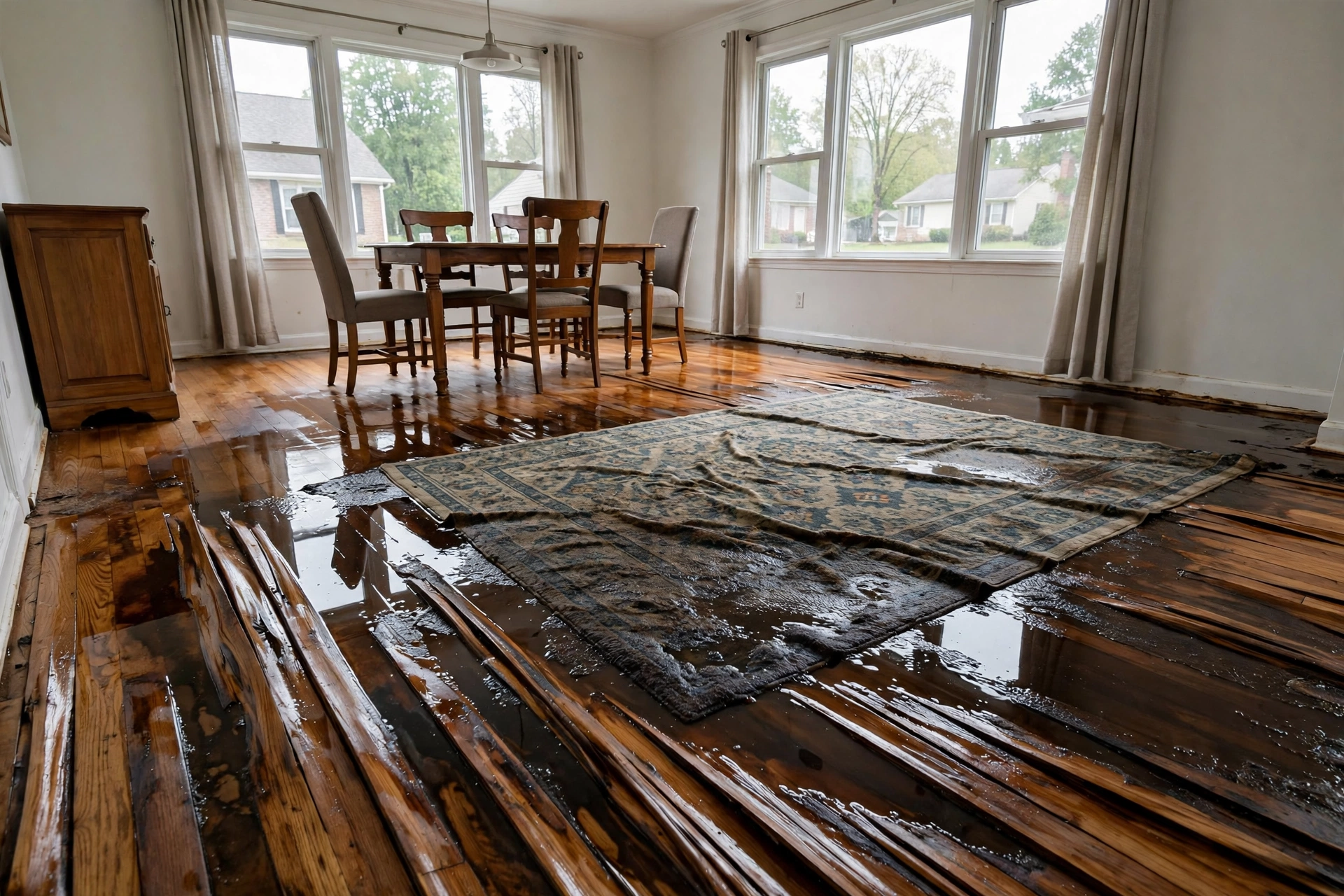
A split refrigerator supply line sent water under the kitchen and dining room hardwood of a Yorktown home built over a 1960s subfloor, and the boards cupped across a wide run before the leak was found. Our crew extracted the water, set drying mats across the affected sections, and tracked board and subfloor readings daily. The floor dried back toward flat and was saved without removal.
No Bowie company publishes a local price list, and the figures here are published figures, labeled that way. Published guides put hardwood floor water damage work at $1,850 to $4,900. Published guides also put water mitigation commonly at $1,300 to $5,800, and the average restoration project at $3,000 to $3,867 in published cost guides. Saving a floor and replacing a floor are different budgets, which is why the range runs wide. Your figure follows the first readings.
Time is the biggest factor. A floor dried within the first day or two has a strong chance. A floor that sat wet for a week under rugs often does not, because boards swelled past the point where they settle back. Water category matters too. Clean supply water is a drying problem, while contaminated water under a floor usually makes removal the right call.
Moderate cupping often relaxes as moisture leaves the boards evenly, which is what mat drying is built to do. Buckling, where boards tent up off the subfloor, is a different outcome.
Published guides put this work at $1,850 to $4,900, with water mitigation commonly at $1,300 to $5,800 in published guides. Your figure follows the first visit readings.
Often, yes. Cupping comes from moisture imbalance through the board, and as mat drying pulls moisture out evenly, many floors relax toward flat. Severe buckling is the case that usually cannot be saved.
Most floors need four to seven days of mat drying and dehumidification, with readings taken daily. Equipment stays until board and subfloor readings reach dry range.
Moving air across the surface does little for moisture trapped under the boards, and heat aimed at a wet floor can dry the top faster than the bottom and worsen cupping. Stop the water and get readings taken.
No. Many appliance and supply line leaks are caught while the floor is still saveable, especially where drying starts quickly. Removal follows buckling, contaminated water, or readings that refuse to fall.
Homeowner policies usually cover sudden and accidental leaks, such as a split supply line. Slow leaks that built up over months are treated differently. We document readings and the affected area for the claim file.
Tell us what got wet and when. We read every request that comes in and respond with the published range for that kind of loss and the next step, starting with a visit to take moisture readings and scope the drying plan.
Prefer to talk it through first? Send the form and we will call you back at the number you give us.