Bowie, Maryland
Mold Remediation in Bowie, MD
Mold Remediation in Bowie, Maryland, with published price ranges up front, the loss scoped with moisture readings on site, and one written figure before any work begins.
Bowie, Maryland
Mold Remediation in Bowie, Maryland, with published price ranges up front, the loss scoped with moisture readings on site, and one written figure before any work begins.
Mold in a Bowie home usually starts as a water story that never got finished. A slow leak under a sink, a basement that stayed damp through a humid summer, a bath fan venting into the roof space. We handle mold remediation in Bowie as physical work: find the moisture source, contain the area, remove growth and unsalvageable material, clean what can be cleaned, and dry the space so growth does not simply return.
One legal fact belongs at the front, because Bowie homeowners hear the opposite in sales pitches. Maryland does not license mold remediation. The state Mold Remediation Services Act ended on July 1, 2019, so no company holds a Maryland mold remediation license today, and any claim of one should be questioned. Our mold work follows the IICRC S520 standard, and the drying side follows the IICRC S500 standard. Those standards guide the method. They are not licenses, and we do not present them as such.
Assessment comes before any removal. We look for visible growth, water staining, warped material, and the musty odor that often points to a cavity problem behind a wall. Moisture meters test the suspect material and the material around it, because mold follows moisture. Bathrooms, basements, laundry rooms, and kitchens lead the Bowie list.
Pointer Ridge and other newer areas add a modern pattern: condensation on cold air conditioning ducts in a humid basement ceiling, dripping onto drywall below for a whole season. Older Belair homes show the classic pattern instead, a cast iron drain with a slow weep inside a wall, feeding growth that stays hidden until odor breaks through.
Visual inspection and moisture readings locate growth and its cause reliably. They do not identify species, and species rarely changes the physical work, since contaminated porous material comes out either way. Air sampling, where a homeowner wants it, is arranged as testing and read alongside the physical findings, never as a standalone verdict.
Containment separates remediation from demolition with good intentions. The work area gets sealed with plastic sheeting, and negative air pressure with HEPA filtered exhaust keeps disturbed spores from drifting into clean rooms. Removed material gets bagged inside containment before it travels through the house.
Removal follows a salvage rule applied without sentiment. Drywall with growth through its paper facing comes out. Wet, moldy insulation comes out. Swollen particleboard comes out. Solid wood framing, concrete, tile, and metal can usually be cleaned in place with HEPA vacuuming and scrubbing, then dried and rechecked. Cabinets are the judgment call of almost every kitchen and bath job: solid wood boxes often clean up well, while pressed wood backs that absorbed months of sink leakage usually do not.
Cleaning extends beyond the visible patch, so the whole contained zone gets HEPA vacuumed and wiped down after removal. Air scrubbing runs during the work and for a period after. Only then does drying bring framing and cavities to dry standard, so the rebuilt wall closes over a dry, clean assembly.
Remediation that ignores the water source is a temporary cosmetic. A sweating supply line, a weeping drain, a foundation joint that admits groundwater, a bath fan dumping moist air into an attic: each will feed new growth if it survives the cleanup. We identify the source in the assessment, state it plainly, and separate what we fix within water damage work from what needs a plumber, roofer, or drainage contractor.
Basement cases tie mold work to sump and groundwater control more than any other pattern. A finished basement in Woodmore or Fairwood that grew mold along its baseboards needs humidity control verified over days, not a single dry reading on a cool morning. Summer humidity alone can keep an unconditioned basement damp enough for surface growth.
After removal and drying, the area is ready for rebuild by whoever handles that phase. We leave a record of what was removed, how containment was run, and the final moisture readings.
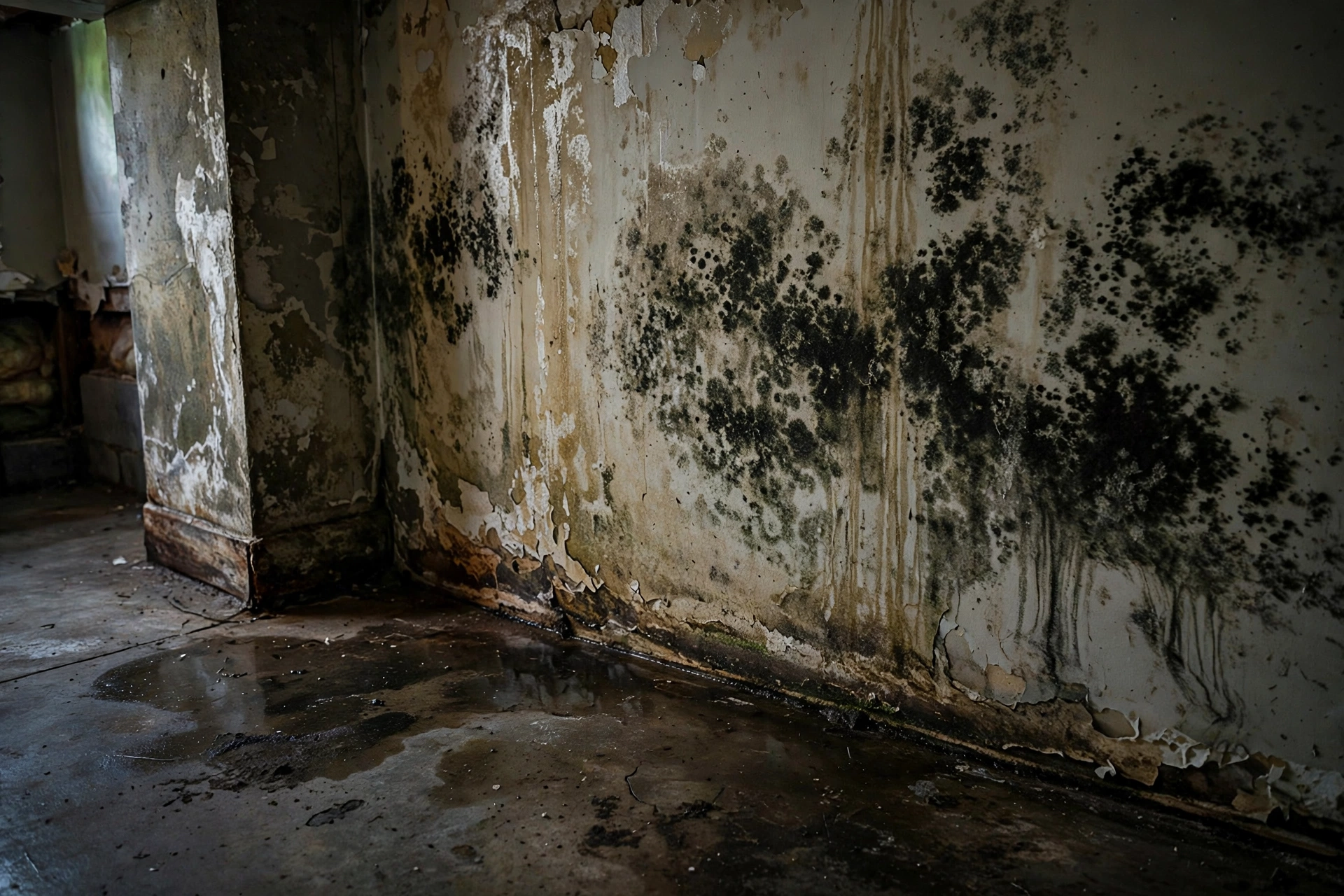
Condensation from cold air conditioning ducts in a Pointer Ridge basement ceiling had dripped onto drywall for a full summer, producing growth across two ceiling sections and the top of one wall. We sealed the work area under negative air, removed the affected drywall and wet insulation, and cleaned the exposed framing and duct surfaces before drying the cavity to standard. The duct condensation source was identified and documented so insulation of the duct run could be addressed before the ceiling was rebuilt.
Inside a closed wall, mold takes longer to reach, and that access problem shapes the price. No Bowie list is published to price it from, so the ranges are published figures from national cost guides, labeled as such. Mold remediation for a typical Bowie home usually falls at $1,500 to $4,800 depending on area and access. Water mitigation commonly runs $1,300 to $5,800 per project. Published guides put an average restoration project at $3,000 to $3,867 across water damage work; a contained single room job lands near that band, while multi room or attic jobs run higher.
Area drives cost, but access drives it almost as much. Growth inside a closed wall or over a finished ceiling takes more containment time than the same area on an open basement wall. Material removal and drying time move the total as well. For context only, published data puts a full insurance claim project including rebuild at around $13,954 on average, an insurance claim figure including rebuild, far beyond a remediation only scope. Your firm figure follows the assessment.
Homeowners ask what a patch of growth means for their family. Mold exposure affects people differently, and anyone with concerning symptoms should talk to a medical professional, because a remediation crew cannot diagnose health effects. The physical side is ours to answer: active growth indoors means moisture is present, materials are degrading, and removal under containment plus a moisture fix is the correct response regardless of species.
Delay helps nothing. A small area handled early often stays a small job, while the same leak given another season can turn one cabinet and a square of drywall into a full room of removal.
Published figures put water mitigation commonly at $1,300 to $5,800, with mold remediation usually at $1,500 to $4,800 for a typical Bowie home. Published guides put an average restoration project at $3,000 to $3,867. Affected area, access inside walls or ceilings, and material removal set your figure, confirmed after assessment maps the full zone.
No. Maryland ended its Mold Remediation Services Act on July 1, 2019, and no Maryland mold remediation license exists today. Be cautious with any company claiming to hold one. Sound selection rests on method instead: containment, removal of unsalvageable material, cleaning, and drying performed following the IICRC S520 standard.
That approach fails on porous material. Bleach can add moisture into drywall and wood while growth inside survives, and paint seals a living problem into a wall. Small surface mildew on tile grout is a housekeeping matter. Growth on drywall, wood, or inside a cavity needs removal under containment.
Our assessment locates growth and its moisture source through inspection and meter readings, which determines the physical work. Species identification rarely changes that work. If you want sampling for health or real estate reasons, we will discuss arranging testing and how to read results beside the physical findings.
Not from the cleaned area itself if the moisture source is fixed and materials are dried to standard before closing. New growth needs new moisture, which is why a recurring leak or damp basement must be corrected for the result to hold.
A single room with contained wall or ceiling work often takes two to four days including drying checks. Larger areas and multi room containment extend the schedule. The assessment gives a realistic timeline before removal begins.
Tell us what got wet and when. We read every request that comes in and respond with the published range for that kind of loss and the next step, starting with a visit to take moisture readings and scope the drying plan.
Prefer to talk it through first? Send the form and we will call you back at the number you give us.